AI aggregators own your mind
Everyone is celebrating AI's democratization. Few are asking what the aggregators are actually accumulating & why it dwarfs every monopoly in history
Naval’s Post on X about the future of the market structure after AI settles.
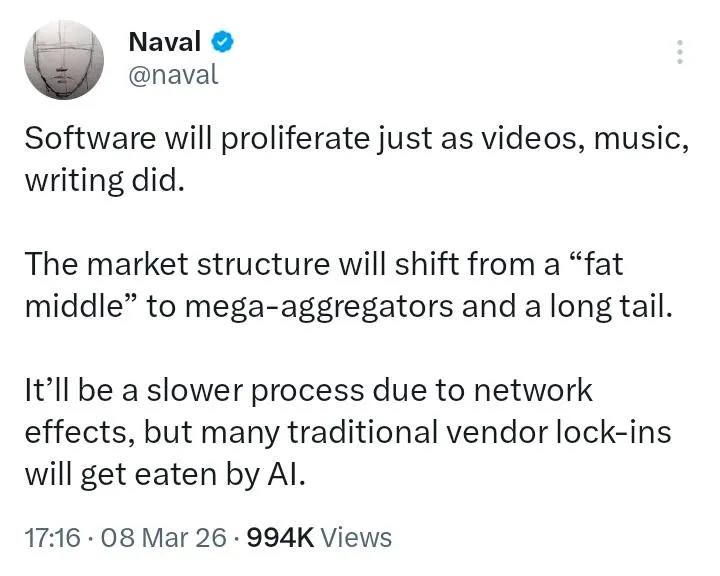
Naval Ravikant recently observed that software will proliferate the way music, video, and writing did, thereby collapsing the middle market and leaving only mega-aggregators and a long tail. He’s right. But the conversation it sparked missed something far larger than market structure. It missed the nature of what the aggregators are actually accumulating.
It isn’t users. It isn’t revenue. It isn’t even market share.
It is behavioral data at civilization scale. That is, the most precise and comprehensive map of human cognition ever assembled. And the implications of that are in a different category entirely from anything we’ve seen before.
The Wrong Conversation
The optimists in the thread were excited about democratization. AI gives anyone with a vision and no dev team the tools to build. Barriers to entry collapse. New winners emerge in the long tail. This is true and worth celebrating.
But celebrating the democratization of building while ignoring the consolidation of behavioral data is like celebrating the fact that anyone can now open a shop on the high street while a single landlord quietly acquires every building on it.
Access to tools is distributed. Access to the map of human decision-making is not.
Previous monopolies could control markets. This one can shape the demand that creates markets before the market even knows it exists.
Pharaoh’s Choice
There is a theological argument that gets closer to the truth than most economic ones.
In the book of Exodus, God hardens Pharaoh’s heart. Pharaoh still experiences himself as choosing to resist, to relent, to resist again. From the inside, it feels like free will. From the outside, the outcome was engineered upstream of the choice itself.
This is not an ancient curiosity. It is the operating model of every major behavioral psychologist working today.
Daniel Kahneman, Robert Cialdini, Richard Thaler and decades of behavioral research converge on the same conclusion: the decisions people experience as free are largely downstream of priming, framing, defaults, and environment. Free will certainly feels real. But research data suggest much of what we experience as choice is shaped long before the moment we decide.
What AI does is not introduce manipulation into human decision-making. Manipulation was always there in advertising, in architecture, in social norms. What AI does is industrialize it, personalize it, and make it invisible.
The Difference Between God and These Companies
God, in the biblical framing, operates with ultimate knowledge of human nature. He knows mankind is proud, fearful, tribal, status-seeking. He engineers circumstances that predictably activate those tendencies.
These corporations know something almost equivalent to that.
They don’t just know that humans are fearful. They know what you specifically fear, inferred from what you scroll past at 2am, what purchases you abandon, what articles you read twice, what you almost said and deleted. They know the particular emotional texture of your decision-making in a way your closest friends do not. They know it quantitatively, and they can act on it at scale, in real time, continuously.
That is not a monopoly on a market. That is something closer to a monopoly on the conditions under which you make choices.
God is singular and just. This is billions of investor funds, funding thousands of engineers to optimize systems against your specific psychological profile, invisibly, every day.
Why Governments Cannot Save You
The standard response to monopoly is regulation. But regulation requires the regulator to possess sufficient understanding of the system to constrain it. That condition is breaking down.
Governments already operate inside an information environment that these companies increasingly define. Political advertising, public sentiment, the framing of policy debates. All these run through the behavioral layer. The regulator and the regulated are not operating on equal epistemic ground. One side has the map. The other is navigating by feel.
This is not a conspiracy. It does not require intention or malice. It is simply the structural consequence of one actor possessing asymmetric knowledge of how a population thinks and decides including the population of people whose job is to constrain them.
The Real Elephant
Naval is right that software will be democratized. He is right about the market structure shift. The long tail will have its tools. The entrepreneurs will have their moment.
But there is a layer beneath the market that the market structure conversation does not touch. The aggregators will own distribution. They will own reach. And beneath both of those, they will own something that no landlord, no king, no industrial titan has ever possessed in human history:
A working model of how you think, updated in real time, optimized continuously, and deployed invisibly.
Every previous concentration of power in history required the consent, or at least the awareness, of the governed. This one does not. It operates beneath the threshold of notice, in the layer where preferences are formed before they become decisions.
That is not a monopoly.
This is God-level power but with no theology to constrain it, no congregation to answer to, and no afterlife to fear.
And we are all Pharaoh.
A note on this essay
This is not an argument against technology or progress. It is an argument for clarity about what is actually being concentrated, and why the usual frameworks for thinking about monopoly power fall short of capturing it.